65 Years Young
Launched in 1961, the Series 2A Land Rover celebrates its 65th birthday this year. We take a look at the most quintessential Land Rover
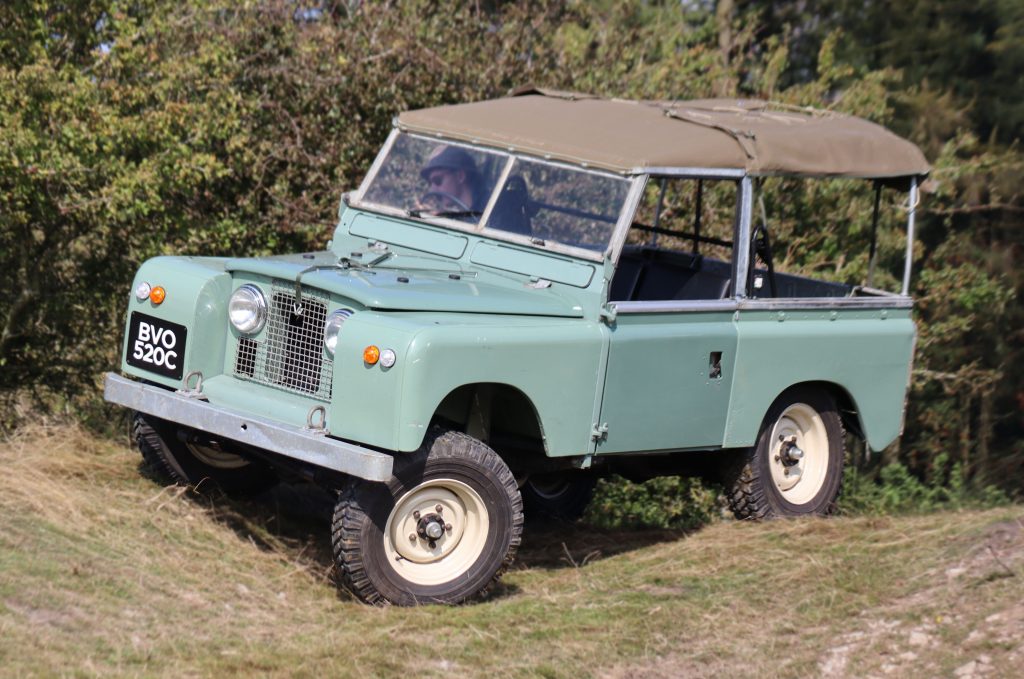
A while back we ran a survey to find the most popular Land Rover, and it was the Series 2A that came out on top. It’s very easy to see why, because for me at least, the Series 2A is the quintessential old Land Rover. Now to be the most quintessential of the old Land Rovers it needs to have two iconic features. Firstly, it has to have the barrel sides, that were first introduced with the Series 2 back in 1958 when David Bache took the Series 1 and flourished it with a little style. And secondly it has to have the lights in the grill. OK I will admit towards the end of the Series 2a’s life the lights were moved to the wings due to lighting regulations, but it is the earlier ones that I find the most appealing.
The Series 2A was first introduced in 1961, meaning it turns 65 this year, a landmark indeed. The jump from the Series 2 to the Series 2A wasn’t a huge development, lets be honest. The ventilation flaps under the windscreen were now spot welded instead of bolted and the Diesel option grew in capacity from 2,052 cc giving 51 hp to 2,286 cc giving 62 hp. The bore, stroke and therefore capacity now matching that of the petrol engine that was first introduced with the Series 2 in 1958.
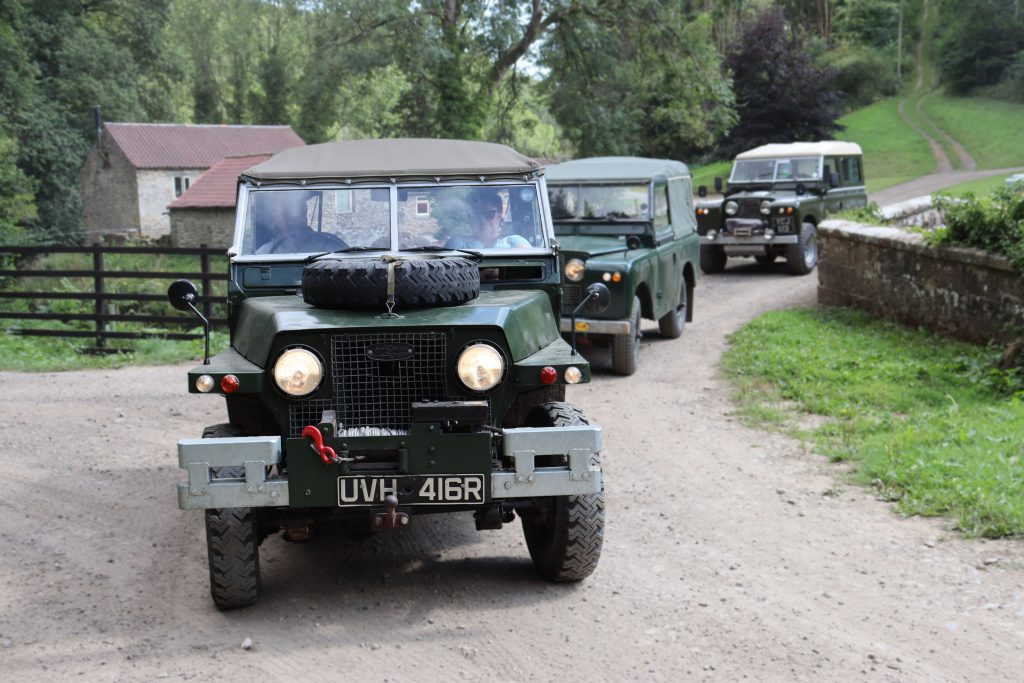
Above – The 1/2 Ton Land Rover aka Air Portable AKA the Lightweight Land Rover was first introduced as a Series 2A model
The Series 2A was as adaptable as it’s earlier siblings, with a whole host of differing body style options available from the factory, not to mention other conversion companies. The wheelbase remained at 88” for the short wheelbase and 109” for the long wheelbase, carried over from the Series 2 and indeed the latter Series 1 offerings. The Military took them in their thousands, and Land Rover even developed a special air portable 88” that could be stripped of many of its body panels to reduce weight. Commonly called the Lightweight Land Rover, these are a popular choice for enthusiasts.
Transmission wise, you had a 4-speed manual gearbox, that lacked synchromesh in first and second gear, meaning you needed to double de-clutch. For those not in the know, this means that when you come to change gear you dip the clutch, take the Land Rover out of gear, lift the clutch, rev the engine to get the engine speed to match what you next need, dip the cutch, put the Land Rover into gear, then lift the clutch again. All quite tricky especially when braking and trying to change down, meaning the learning of the heal and toe method where you rev the engine and apply the brake using the same foot. Towards the end of the Series 2A’s life some were fitted with a Series 3 synchromesh box, however. The Series 2A was predominantly rear wheel drive, and then when the going got tough you would press the yellow know down to engage drive to the front axle. When the going got really tough, and low range was needed, the red lever would be pulled towards you, the yellow knob would pop back up, and you now had four-wheel drive but with a lower range of gears.
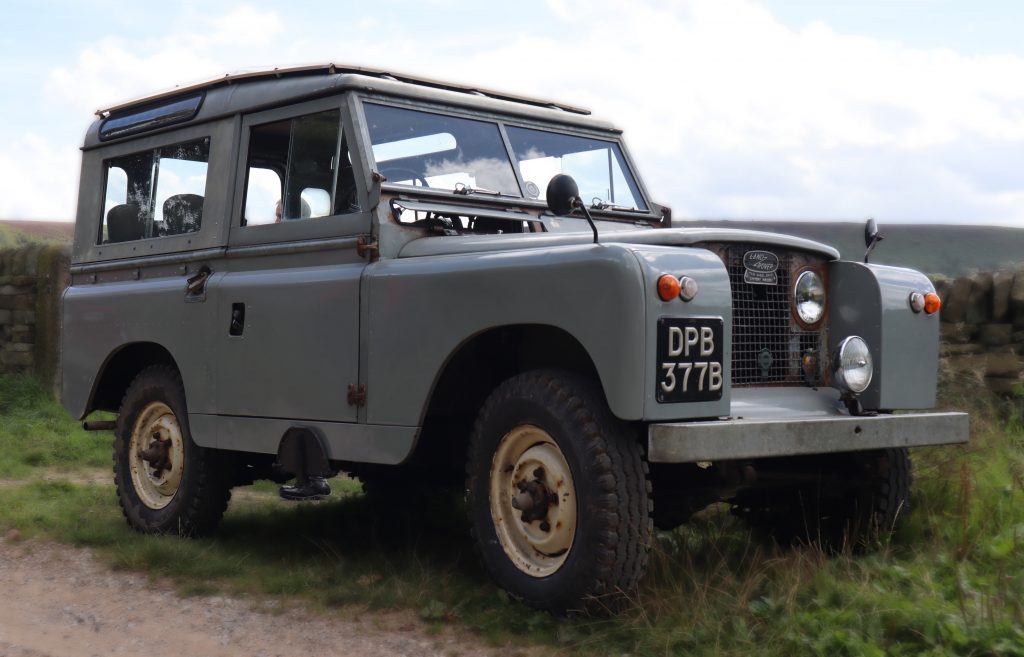
Above – This Series 2A 88″ Station Wagon is a very honest example.
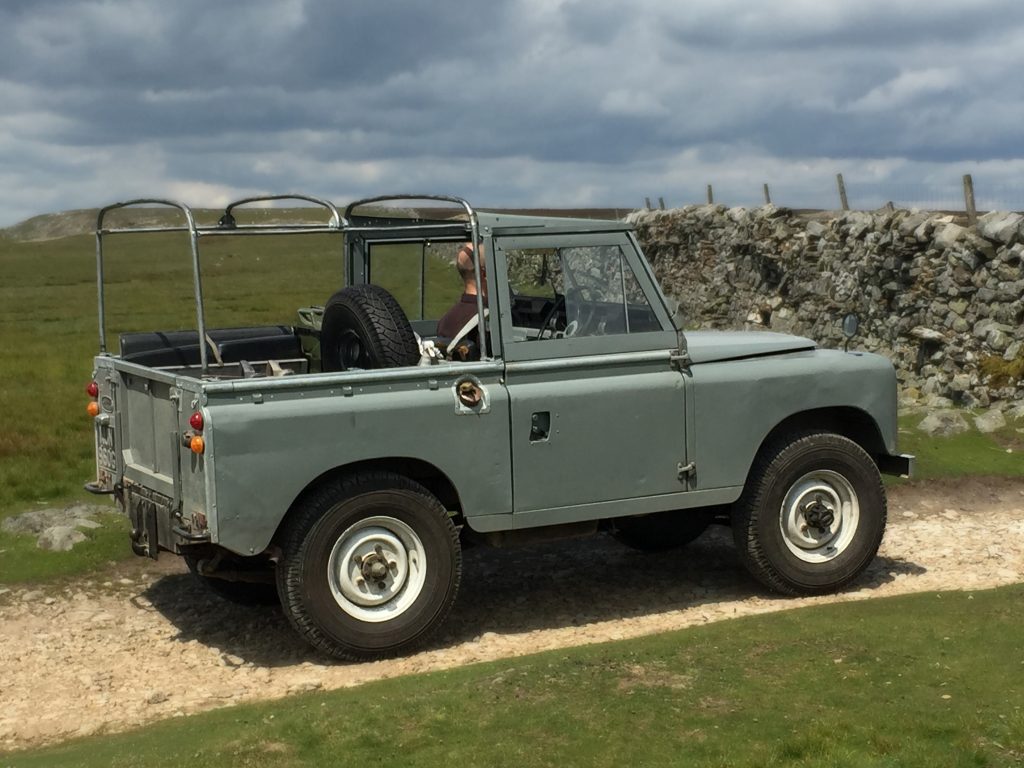
So, what are they like to run and own? Well, I currently have 3 of them in my fleet. My first 2A, called Terry 2A, is a August 1971 88” Hard Top, now Soft Top, bought as we are the same age as each other. Now the smarter of you will now note my hypocrisy and point out that this has the lights in the wings despite my earlier comments about likely the lights in the grill. True and indeed guilty as charged, which is why my Second Series 2A (Called Minty) is an Ex-military 109” built in 1967. Lights firmly in the grill here, I can assure you. Finally, there is the renovation project Timmy, a 1968 (Lights in the grill I may add) 88” Station Wagon. Maintenance wise, they are simple to work on, with loads of room around the engine and underneath. Parts are usually readily available and on the whole not too expensive. Driving wise, they are slow. Noisy. Thirsty. Uncomfortable. Hard to steer. Hard to stop. I love driving them, as you have to drive them. You need to plan ahead as your braking points are somewhat different to a modern vehicle. You need to work the gearbox if you live in a hilly area (as I do), and if you have one that is fitted with overdrive get used to using this as a splitter gear meaning gear changes can sometime mean moving two levers!
Below – For the taller driver, the 109″ is the better proposition as it has more room up front and the ride is better thanks to the longer wheelbase.
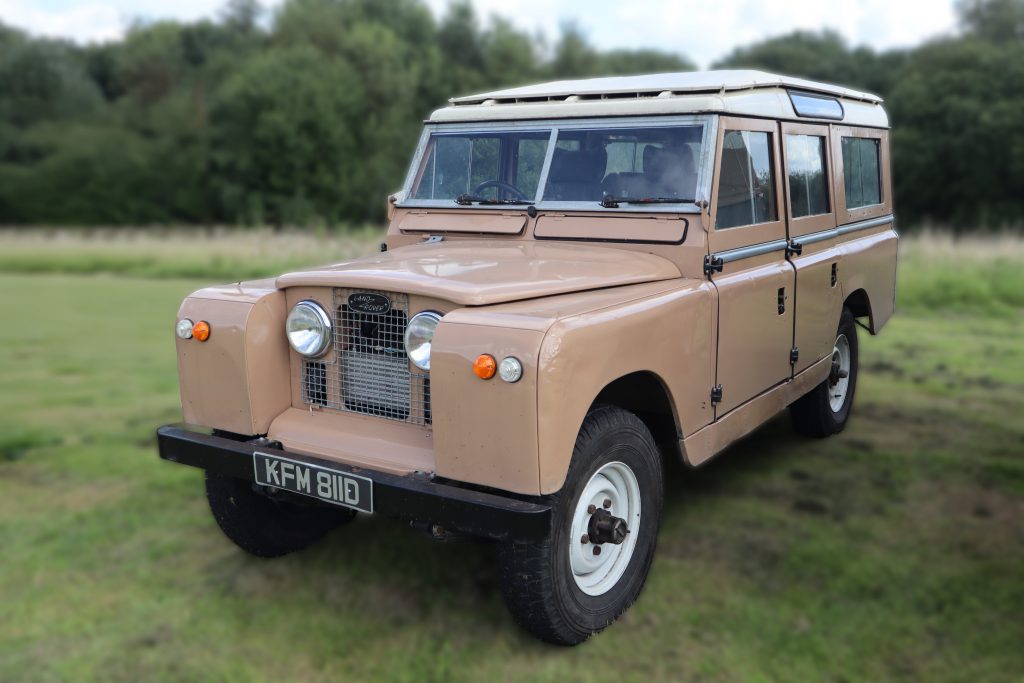
Ride wise, I prefer the 109” and it is less bouncy that the 88” and being tall, the bulkhead is further back in the 109” meaning more room for me. But that being said, the 109” can be more cumbersome when off roading, so the 88” is my choice here.
Over its 10-year life span the Series 2A developed. As mentioned, the lights moved to the wings, the side sills became thinner and more elegant, and in 1967 the 6-cylinder Rover engine was added as an option to the 109” to give it more power and torque. The Series 2A also spawned a Forward control variant but that story is for another day. In October 1971, the Series 3 was introduced with its dashboard, synchromesh gearbox and plastic grill. The Series 2A has a strong and loyal following in Land Rover circles and I use mine regularly. I always have a smile when I drive it, every journey is an adventure. Sure, my apple watch beeps as it warns me, I am in a loud environment. The range is woeful due to a small tank and 20 mpg and upon every hill I seem to create a tailback, but you know what? Its all about smiles per miles.
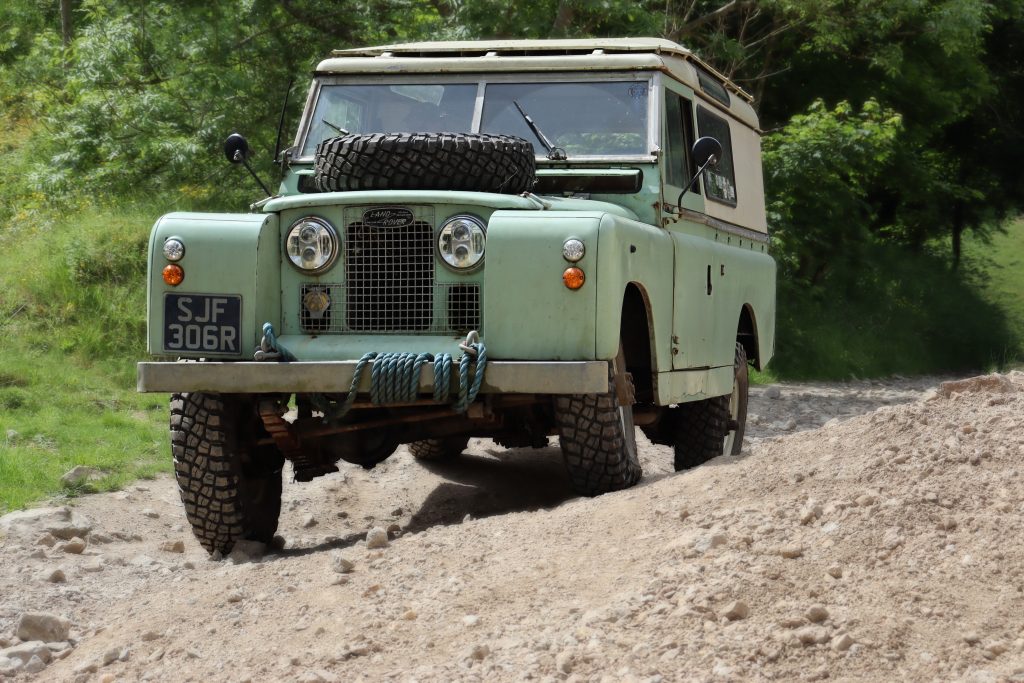
Below – The owner of this Series 2A enjoys some summer motoring.