The Evoque Effect: How the baby Range Rover changed everything
This year we celebrate the 15th Anniversary of the launch of the Range Rover Evoque. Not one for the traditional Land Roverist, however the Evoque brought a new type of clientele to the Land Rover brand.
Words & Pictures – Ian M. Garner
Back in 2008 at the Geneva Motor show, Land Rover first showed its latest concept vehicle the Land Rover LRX. Unlike anything they had shown before, the LRX was smaller and sleeker than the Freelander 2, and it clearly aimed at a different clientele to the usual Land Rover customers. The public had to wait until the 2011 Geneva motor show for the official unveiling. No longer badged the Land Rover LRX, but the Range Rover Evoque the model, in 2 door coupe guises, was incredibly similar to the concept model. The UK were introduced to the Evoque at Earls Court in May 2011, over a three-day event, and this year marks the 15th anniversary of the Launch.
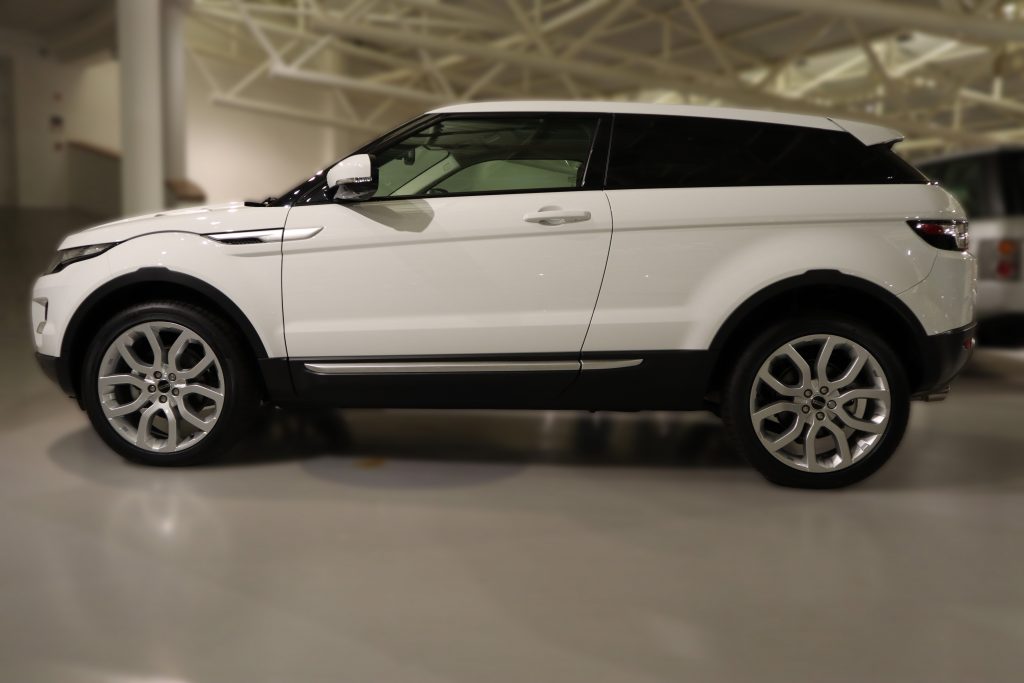
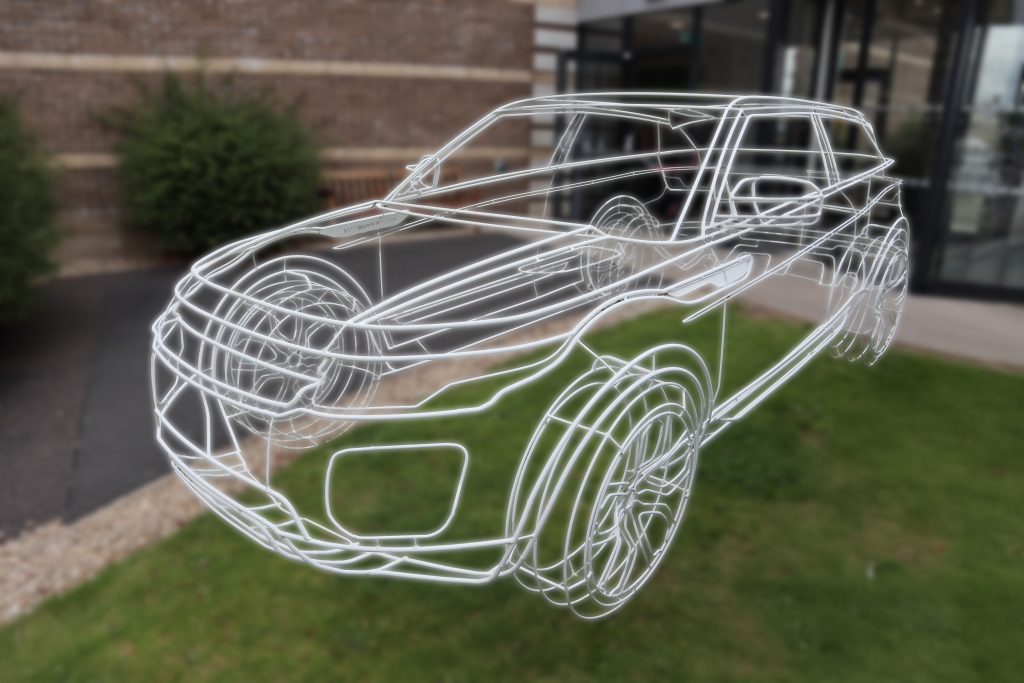
Above – This 3 Door Coupe was the first production model, and is incredibly similar to the LRX Concept first shown in 2008. Below – During the launch the advertising campaign was called Hello Evoque. Wire frame models were pictured in various locations prior to the unveiling.
At the launch three different trim levels were introduced. The Pure, the Prestige and Dynamic. Being the sport version, the Dynamic had adaptive suspension and a dynamic mode in Terrain Response which made the instrument panel glow red when selected mimicking the feature first seen on the LRX Concept. Despite its smaller dimensions the Evoque was marketed as a luxury SUV, it was after all a Range Rover, so it had to match certain expectations. Upon its initial launch two different engines 2.2 litre turbo diesel engines (150 & 190 PS) and one two-litre turbo petrol engine offering 240 PS. The Diesels (TD4 and SD4) could be had with a six-speed manual gearbox or a six-speed automatic whereas the petrol (Si4) was automatic only. Hill Descent and Terrain Response were standard on the all-wheel drive Evoque’s, the Terrain Response having four settings of Normal Drive, Grass / Gravel / Snow, Mud & Ruts, and Sand. Each changes the throttle response and traction control settings of the vehicle. Two body styles were offered at launch for the Evoque. One was the sleek three door coupe of the LRX concept vehicle and the other being a more family orientated five doors. to offer an optional panoramic roof giving the cabin a light and airy feel.
In 2013 the Range Rover gained another first for the 2014 model year. The world’s first production nine speed automatic gearbox. Manufactured by ZF, Land Rover were chosen as the first manufacturer to showcase this advanced technology. Despite its three extra ratios over the outgoing gearbox the nine speed was only marginally longer but weighed 7.5 kg less. Due to the extra ratio’s the gearbox had the ability to skips gears on the change down. The gears can be changed by paddles on the steering wheel or by leaving the box in drive or sport and letting the car make the changes itself. Also introduced on the 2014 model year was what Land Rover called Active Driveline. In a bid to improve fuel efficiency, the rear axle was mechanically disconnected from the front leaving the vehicle in front wheel drive only at speeds above 22 mph. The system continually monitored the traction and if all wheel drive was needed the rear axle would automatically reconnect to provide drive. Initially only available on the Si4, this system would later become options on other models.
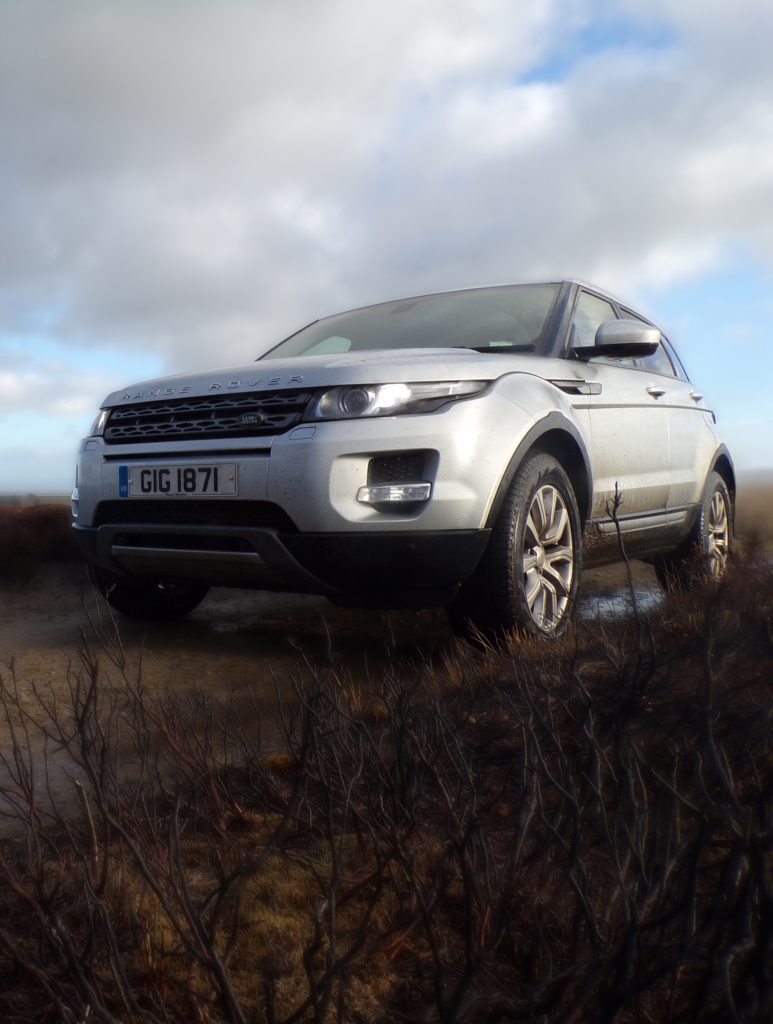
Left – I actually ran a 2014, SD4 with 9 speed auto for several years, and unlike the majority of owners I did take mine greenlaning. Not having the ground clearance of its larger siblings, you do have to pick your lines with greater care, but but a low first gear and terrain response did give class leading off road ability.
Sitting above the Prestige, 2015 saw the introduction of the Autobiography and Autobiography Dynamic models. With a tuned two-litre Turbo petrol engine the Autobiography Dynamic boasted 285 PS and could do the 0 — 60 mph dash in 6.7 seconds making it the fastest Evoque manufactured. Also introduced as part of the 2015 model year was a new body style: the Range Rover Evoque convertible. This was the first time a premium SUV had been offered as a convertible by any major vehicle manufacturer.
When the 2016 model year was announced it brought a host of changes, not least the cosmetic changes of its midlife face lift. The 2016 models could be easily recognised by the position of the fog lights which were now situated higher in the bumper. The 2.2 Turbo Diesel engine that had powered the eD4, TD4 and SD4 models was discontinued and replaced by an all-new Land Rover designed Ingenium two litre turbo diesel. This gave power output of 150PS for the eD4 and TD4 and 180PS for the SD4. Whilst the SD4 was slightly lower on power that the outgoing version a modest increase in torque ensured that the performance remained the same. The lower emission diesel engines were designated by a blue Evoque badge to show off the vehicles environmentally friendly credentials. Trim levels were also revised in a bid to align with other Range Rover models. You could now have Pure, SE, HSE, HSE Dynamic and Autobiography versions.
After the replacement of the diesel engines with Land Rovers own Ingenium version the 18MY saw the same change to the petrol engines. The lower output version remained at 240PS, however the higher output version now offered 290PS making it the fastest and most powerful Evoque to date with a 0—60 time of 6.3 Seconds. The two-litre diesel also had a power hike too and could now be had with 240 PS and 500 NM of Torque, as well as the previous 150PS and 180PS outputs.
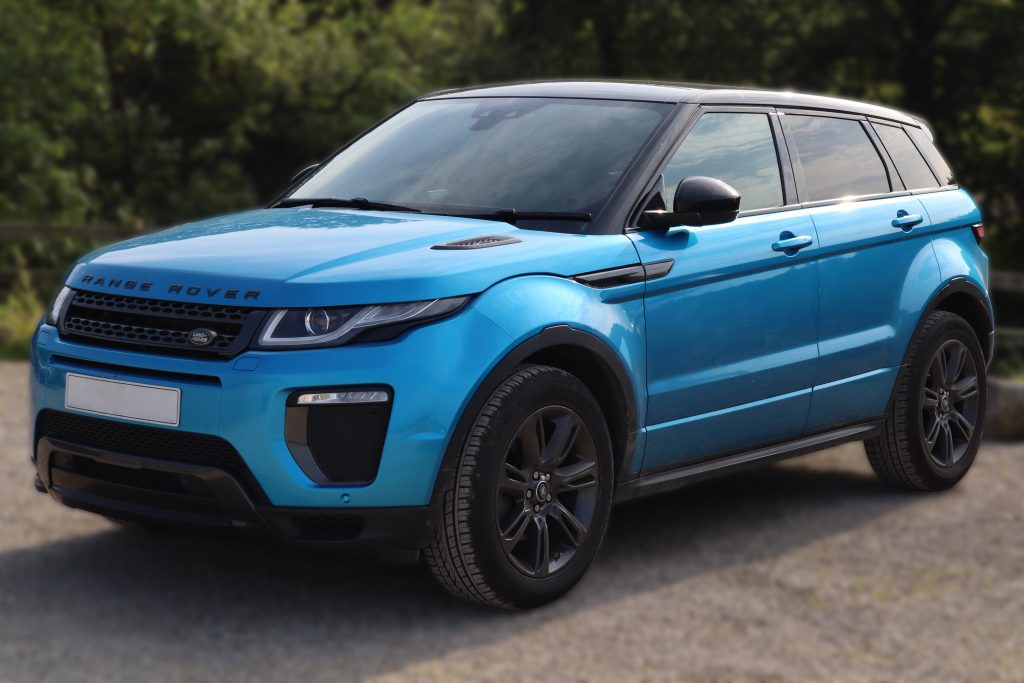
Above – The 16MY brought a mid life face lift, recognized by the higher position of the front fog lights. This is a Landmark Edition, which came in this rather lovely shade of blue.
Launched towards the end of 2018, the New Evoque looked largely unchanged from the outgoing model, and this was on purpose. The outgoing Evoque was still a good-looking vehicle so why change a winning formula? The door handles were now flush with the bodywork, a styling cue taken from the Velar and the rear had a full black plastic strip where the Range Rover badging was now located.
The new model came with MHEV (Mild Hybrid Electric Vehicle) on all but the base two-wheel drive models. This was the first time Land Rover had offered this technology as standard on any vehicle and demonstrated the company’s commitment to lowering its emissions. This system would complement the petrol or diesel engines using a 48v electric motor that would be charged during normal driving of the vehicle rather than a plug-in variant.
At launch there were seven variants of engine and transmission available. The Base model was a front wheel drive only 150PS turbo diesel with a manual gearbox. All other models offered the nine-speed automatic gearbox with MHEV technology. Like the outgoing model, the two-litre turbo diesel Ingenium engine was available in 150PS, 180PS and 240PS outputs, called the D150, D180 & D240. The two-litre turbo petrol Ingenium engine was available in 200PS, 250OS and 300PS outputs called the P200, P250 and P300.
There were six trim levels for the Evoque at launch S, SE and HSE as either an R-Dynamic or Standard version. The R-Dynamic brought enhanced styling features over the standard Evoque.
As you would expect the Evoque on road manners had been improved by utilising clever technologies. All four-wheel drive models came with Driveline Disconnect which would mean the vehicle would run in front wheel drive only mode to help reduce drag when all wheel drive was not needed. The full all-wheel drive system would automatically reconnect as and when required. The Active driveline was available on the D240 and P300 models and gave torque vectoring and the ability for the vehicle to lock its rear differential when further traction was needed. The on-road manners could be further enhanced with adaptive dynamics which would optimise the damper settings 100 times a second.
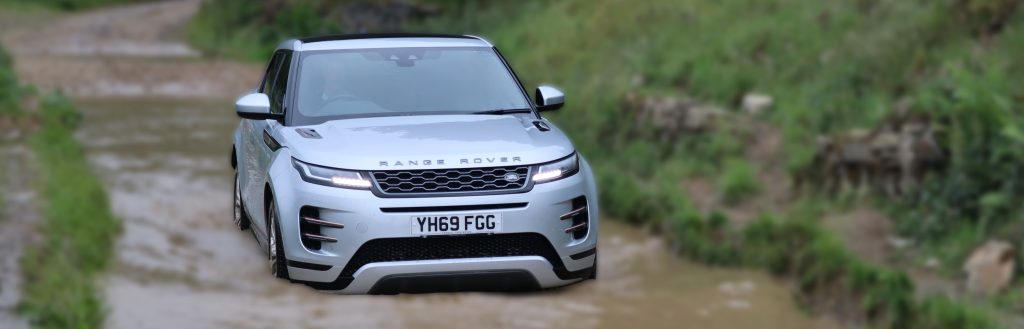
Below – When a friend purchased his new Evoque, he was keen to see what it was like off the tarmac highway.
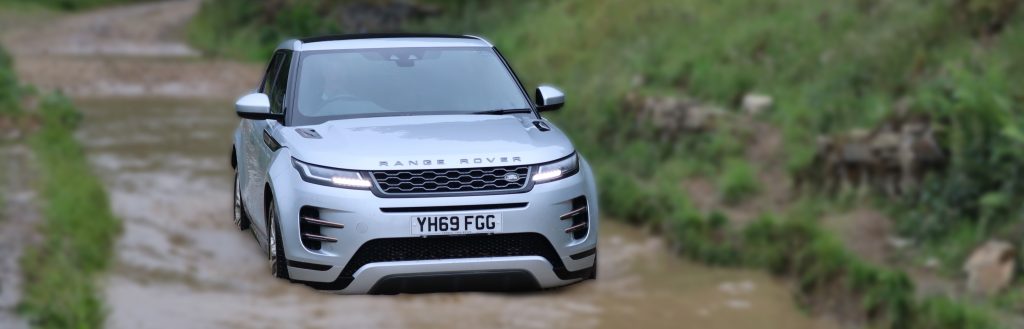
The technology didn’t just stop at the on-road dynamics. Being a Range Rover best in class off road ability was also necessary. Power was controlled fore and aft as required with 100% of power being able to be transferred to either axle if the situation required. The hill descent control and terrain response system of the previous Evoque were maintained but could be enhanced with the optional Terrain Response 2 which came with an automatic mode allowing the vehicle to change its own settings to suit the terrain as it deemed fit. The Evoque could also be had with Land Rovers ATPC system which was an off-road cruise control that would keep the vehicle at a set speed between 1 to 18 mph. The wade depth increased by 100 mm over the older model to a class leading 600 mm and the depth could be monitored by the optional wade sensing technology. The Evoque also came with Low Traction Launch which would control torque to allow the vehicle to start moving on even the most slippery of surfaces. One clever feature that Land Rover was starting to offer on its models was clear sight ground view. Using the optional 360° camera system the ground immediately in front was shown on the touch screen with a graphic showing where the wheels were, allowing the vehicle to be precisely placed when driving off road.
In 2020 a new Evoque model was announced, and probably the most important one since the launch of the original. For the first time the Evoque would be available as a plug-in hybrid. Powered up front by a new 1.5 litre three-cylinder petrol engine, this was the smallest capacity engine ever fitted to a production Land Rover vehicle. With the clever use of turbo charging this little engine could produce 200 PS. The petrol engine would only power the front wheels. The rear axle was powered by an electric motor delivering an additional 109 PS, giving the Evoque an impressive 309 PS. For the first time, the four-wheel drive system was not mechanical. When off road capability was needed the petrol and eclectic engines would combine to give all wheel drive.
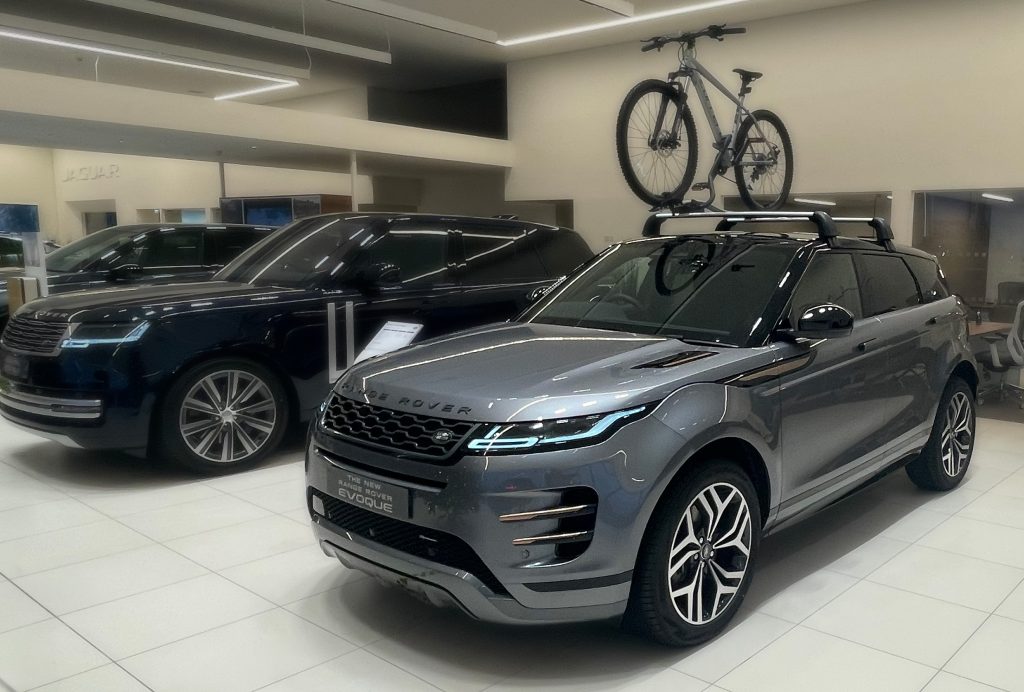
Above – This R-Dynamic was pictured at a local dealership. With a mountain bike on the roof rack, the Evoque was marketed as a premium lifestyles SUV.
A few months after the launch of the P300e, the new 21MY engine line up was announced featuring the latest generation of petrol and diesel Ingenium engines. The diesel options of D150 and D180 were replaced. The D165, was available as a two-wheel drive manual or four-wheel drive automatic version. The D240 was also dropped leaving the D200 as the most powerful turbo diesel. The three-cylinder petrol engine from the PHEV was available with two-wheel drive and an eight-speed automatic (as opposed to the nine-speed automatic used in other variants) and was called the P160. A four-cylinder turbo petrol engine was also available with MHEV technology and was offered in three different power outputs of P200, P250 & P300. All came with 4-wheel drive and the automatic transmission.
In 2024, the Plug in Hybrid’s power output quietly dropped for 309ps to 270ps. In the UK at least, there were only 4 different power trains on offer the D165, the D200, the P160 and the PHEV. The Evoque was a popular model from the get-go, and you still see many around. The last version was launched 8 years ago, and its sales have been in decline as it has started to show its age compared to more modern rivals. Currently there is no official line on when the Evoque will be replaced, but rumours suggest it is still a few years away. The replacement is likely to be an all-electric vehicle too due to the way the industry is going. It no doubt that the Evoque was a sales success for Land Rover, lets hope when it is replaced the new model can generate the same levels of interest.